If you’re new to travel trailers, one of the most confusing things to figure out is what runs on the battery and what requires shore power.
In a recent post about what you actually need to start dry camping, I mentioned that it’s important to understand where your power comes from. But knowing that you should understand it and actually knowing how to tell are two different things.
The good news? You don’t need to understand electricity to figure this out. There’s a very simple way to identify what runs on battery power in your trailer. By the end of this article, you’ll know exactly how to do it.
Rogina Roaming is supported by its audience. When you purchase through links on our site, we may earn an affiliate commission at no extra cost to you.
Battery vs Shore Power
At a high level, your trailer has two power systems:
- 12-volt power (battery power)
- 120-volt power (shore power)
The 12-volt system runs off your trailer’s battery.
The 120-volt system requires your trailer to be plugged in to shore power.
In general:
- Battery power runs the basic trailer functions
- Shore power runs household-style appliances
If it feels like something you’d normally use at home, it probably requires shore power. If it’s a basic built-in function of your trailer, it likely runs on the battery.
That’s the big-picture view. Now let’s make it practical.
How to Tell What Runs on Battery
A simple rule of thumb:
- If it looks like a standard household outlet, it requires shore power.
- Basic features like lights, USB ports, and fans typically run on the battery.
If something plugs into a normal wall outlet like you have at home, it generally won’t work unless your trailer is plugged in.
However, there can be exceptions.
For example, some trailers use an inverter that allows certain outlets to run off the battery. And sometimes USB ports are connected indirectly to shore power without it being obvious.
In our trailer, we have a pop-up tower with standard outlets and USB ports. On our first dry camping trip, we assumed those USB ports would work off-grid. What we didn’t realize was that the entire tower was plugged into a standard household outlet under the bed. That meant the USB ports didn’t work unless we were connected to shore power.
Which leads to the most reliable method of all…
Test at Home
If you want to know for sure what runs on your battery, unplug your trailer before you leave home.
While it’s sitting in your driveway:
- Unplug from shore power.
- Turn on the items you plan to use while dry camping.
- See what works.
If it works unplugged at home, it will work while you’re dry camping.
If it doesn’t, you know you’ll need a different plan.
You’re not going to hurt anything by testing this. You’re simply learning how your trailer behaves. This is the easiest and most stress-free way to avoid surprises at the campsite.
Breakers vs Fuses
Another way to get clues is by looking at your converter panel.
Most trailers have a panel that contains both:
- Breakers (for shore power)
- Fuses (for battery power)
Anything connected to a breaker requires shore power.
Anything connected to a fuse runs on the battery.
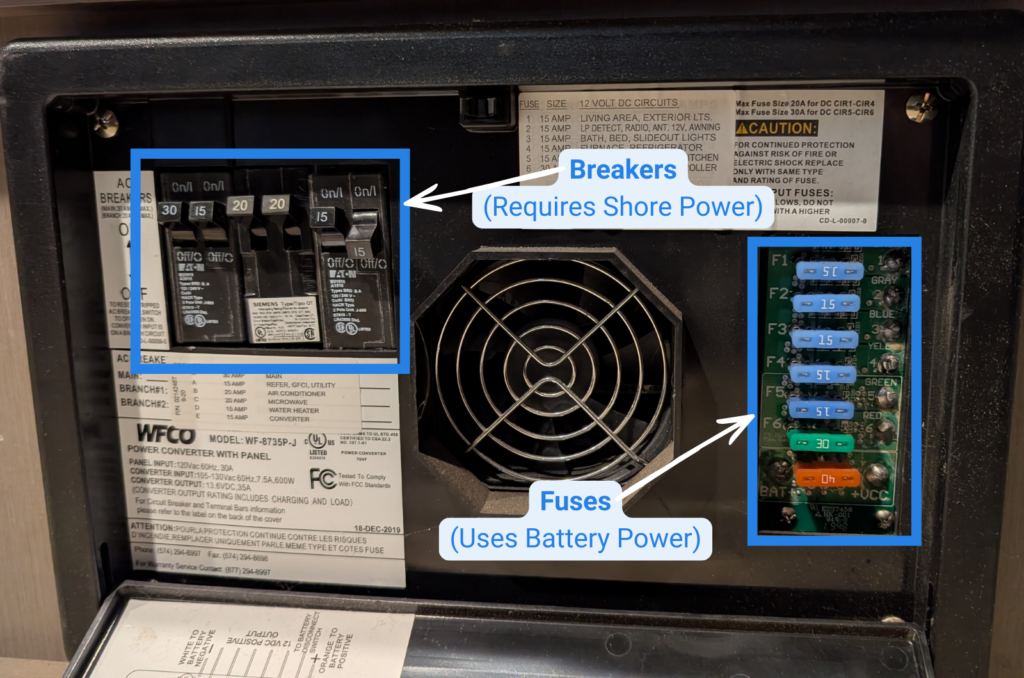
This method depends on the panel being labeled clearly, which isn’t always the case. But if it is labeled, it can help you identify what powers different areas of your trailer.
Even if it’s not perfectly labeled, just knowing that breakers = shore power and fuses = battery can give you a helpful starting point.
Appliances That Use Both
Some appliances are “gray area” items because they use multiple power sources or give you options.
Here are a few common examples:
Refrigerator
Depending on your model, your fridge may:
- Run on 12-volt battery
- Run on propane
- Run on 120-volt shore power
- Or offer multiple options
For dry camping, propane is often the best choice for two-way refrigerators. Check your fridge controls to see what options you have. Ours has “Gas” and “Auto,” which allows us to choose the most appropriate power source.
Furnace
Your furnace uses propane for heat, but the fan runs on battery power. So even though you’re using propane, you’ll still draw from your battery when the furnace runs.
Water Heater
Most water heaters can run on either propane or shore power. If you’re dry camping, you’ll want to make sure it’s set to propane rather than electric mode.
The key takeaway: it’s normal for some appliances to use more than one power source. You just need to know how yours works before you leave.
Conclusion
If you’re unsure what runs off your trailer battery, the simplest answer is this: unplug your trailer and test it.
There are rules of thumb you can follow, and clues in your breaker and fuse panel, but nothing is more reliable than checking it yourself before your trip.
Understanding where your power comes from helps you:
- Avoid dead batteries
- Make a realistic dry camping plan
- Feel more confident at your campsite
You don’t need to become an electrical expert. You just need to take a few minutes at home to see what works.
Happy camping!