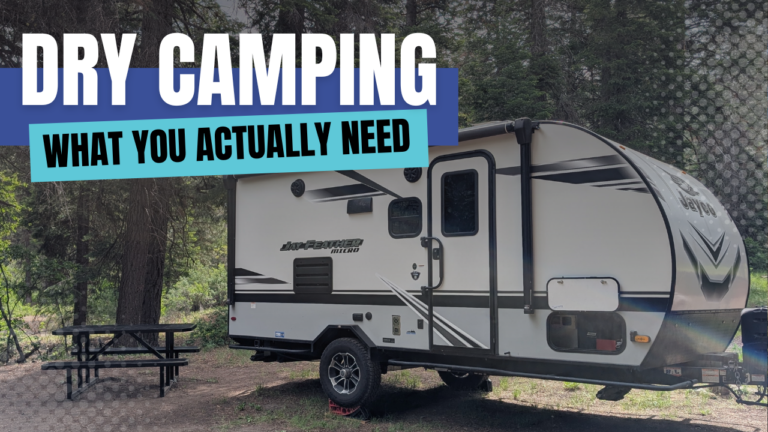
Managing your water and filling up your tanks too fast is one of the biggest dry camping fears. Here’s how to get an idea of how long you can expect your fresh water, gray, and black tanks to last while dry camping and how to better gauge the level of your tanks along the way. In this article, we’ll break down each tank, how to estimate how much life you have left in them, and a few tips to stretch them as far as possible.
Rogina Roaming is supported by its audience. When you purchase through links on our site, we may earn an affiliate commission at no extra cost to you.
Types of Tanks and Their Sizes
Your RV trailer has three different tanks, each serving a specific purpose. And knowing the size of each tank is the first step in understanding how long they’ll last.
The fresh water tank is where you store the water you’ll use inside your trailer when camping somewhere without a water hookup. The gray tank is where water drains when it comes from your sink or shower. And the black tank is where everything goes when it’s flushed down the toilet.
Tank sizes are measured in gallons. For reference, our trailer has a 55-gallon fresh water tank, a 30-gallon gray tank, and a 30-gallon black tank. And while it’s good to know the size of your tanks, the size is less important that the usage. How much water you’re actually using day to day is going to have a bigger impact on how long your tanks last than their size alone.
Why You Can’t Always Trust Your Gauges
Your trailer comes with gauges that tell you whether your tanks are one-third, two-thirds, or completely full. While these are helpful, they aren’t always reliable. The sensors inside can get dirty over time, and sometimes they’ll read at two-thirds forever and then suddenly jump to full. Think of the gauges as a rough estimate rather than something you can fully depend on.
So if the gauges aren’t reliable, how do you actually know how full your tanks are? Here’s how we think about each one.
How to Gauge the Tanks
Gauging the Fresh Tank
With the fresh water tank, you’re not trying to gauge how full it is, you’re trying to figure out how long it will last before it empties. There are two good ways to do this.
The first is simply to test it. Fill the tank up, use it as you normally would, and keep track of how many days it lasts. It’s not super helpful the first time through, but once you’ve done it, you have a solid frame of reference for future trips.
The second method is to estimate based on flow rate. When you’re dry camping, you use your fresh water by turning on your water pump, which pushes water through your faucets and shower head. The average RV water pump has a maximum flow rate of 3 gallons per minute, but your fixtures will bring that number down. In practice, most faucets and shower heads use closer to 1.5 to 2 gallons per minute.
Using that, you can do a quick calculation. Our trailer has a 55-gallon fresh water tank. At 2 gallons per minute, we could run the water continuously for about 27.5 minutes before the tank runs dry. That might not sound like much, but keep in mind you’re rarely running the water non-stop. Brushing your teeth might only use the water for about 20 seconds. The bigger culprits are things like letting the water run while doing dishes, which is why we use buckets instead of letting it drain straight down the sink.
Understanding how much fresh water you’ve used also gives you a clue about your gray and black tanks, because all that water has to go somewhere.
Gauging the Gray Tank
The gray tank collects everything that drains from your sinks and shower, and it will often fill up before your black tank does. The biggest contributor is dish water.
One trick we use is placing a bucket inside the sink to catch dish water instead of letting it drain straight into the gray tank. Many campgrounds have a designated spot where you can dump dish water, which can significantly extend how long your gray tank lasts.
As the gray tank starts to get full, you’ll likely notice the water draining more slowly from your sink or shower. You may even hear gurgling sounds. Those are your signs that you’re only a few gallons away from a full tank.
Gauging the Black Tank
With the black tank, it’s important not to over-conserve. You want to make sure there are enough liquids in the tank so that everything dumps out properly when the time comes. Don’t minimize liquids to the point where the tank only has solids in it.
As a rule of thumb, each flush adds between half a gallon and one gallon to the black tank. That gives you a simple way to estimate how much capacity you’ve used and how much you have left.
Practice Before You Go
If you’re nervous about managing your tanks, one of the best things you can do is practice at a full-hookup campground without actually connecting. Camp as if you’re dry camping, don’t use the hookups, and see how long your tanks last. If something goes wrong, you’re right there with hookups as a backup. You can connect, deal with it, and then figure out how to adjust your habits so you can go longer next time.
Tips to Make Your Tanks Last Longer
Here are a few practical tips to help you get the most out of your tanks:
Start with a full fresh water tank. Whether you’re filling up at home or at an RV water station near the campground, have a plan and make sure your tank is topped off before you arrive at your campsite.
Make sure your gray and black tanks are empty. Dump before you arrive. You want to pull into your campsite with empty gray and black tanks and a full fresh water tank.
Bring extra drinking water. We bring one gallon of drinking water per person per day, including travel days, just to give us a cushion. That water is our go-to for filling water bottles and cooking, while the fresh water tank is reserved for handwashing and dishes.
Know where the nearest dump station is. Hopefully you won’t need it, but if something comes up, it’s good to know where you can go to dump your tanks and reset.
Use paper plates. If you’re worried about running low on fresh water or filling your gray tank too quickly, fewer dishes means less water used.
Conclusion
When you’re first starting out with dry camping, managing your tanks can feel stressful. But the more experience you get, the more natural it becomes. Eventually you’ll develop a sense for how long your tanks will last based on your habits and the length of your trip and you’ll find you’re barely checking the gauges at all.
With a little preparation and a few smart habits, you’ll be able to dry camp with confidence. Have questions about managing your tanks or tips of your own to share? Drop them in the comments below, we’d love to hear from you!